Application criteria

Greenshine Outdoor Lighting by Visual Task and Site Constraint

Roadways, parking areas, pathways and sports grounds create different distributions, observer positions and maintenance risks. These application notes frame the questions that precede product selection.

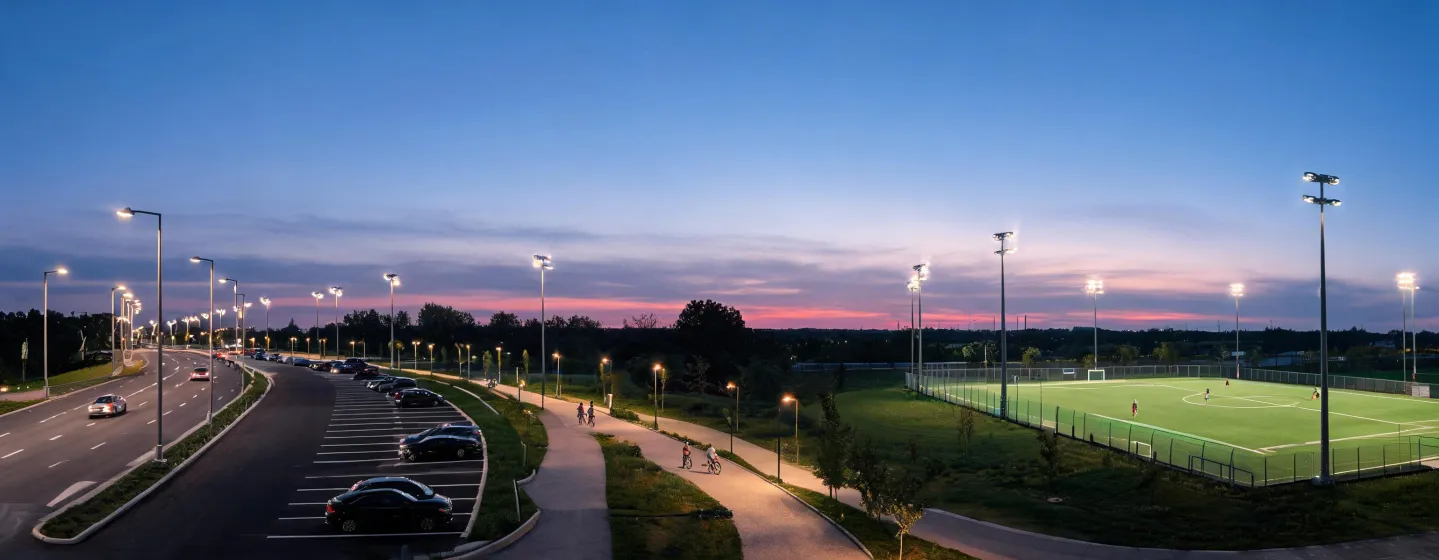
Outdoor infrastructure lighting applications at dusk
R

Municipal Roadways

Road class, lane width, pole setback and mounting height govern spacing and distribution. Review average and minimum illuminance, uniformity, disability glare and BUG rating together. Solar operation also requires a traceable nightly load profile and site-specific irradiation source.

P

Parking and Perimeters

Drivers and pedestrians need readable transitions, not isolated maximum values. Perimeter spill, camera exposure, accessible routes and emergency operating policy affect optics, CCT and controls. Pole locations must remain coordinated with islands, drainage and vehicle impact zones.

T

Trails and Campuses

Low mounting and ecological context can make glare and spectral choice more important than raw efficacy. Programmed dimming may reduce late-night output, but occupancy response, minimum safety levels and local curfew requirements need documented agreement.

S

Sports and Recreation

Player sightlines, ball tracking, spectator comfort and nearby properties create competing aiming requirements. Horizontal illuminance alone is incomplete; vertical values, glare zones, pole height, beam angle and control scenes should be reviewed in the layout.

Technical Requirements Are Application-Specific

DecisionRoadwayParkingTrailSports
Primary evidenceCandela distribution and spacingUniformity and boundary lightLow-angle glare and operating profileAiming, vertical illuminance and glare
Typical specification fieldsMounting height, BUG rating, CCTFlux, optics, IP rating, controlsCCT, dimming, autonomyBeam angle, aiming, control scenes
Known boundaryField geometry can invalidate nominal spacingObstructions create dark zonesVegetation changes solar accessSpill criteria may limit aiming freedom

Efficacy versus visual comfort

Maximizing lm/W can lower connected load, yet narrower high-output distributions may raise glare or reduce useful vertical light. Compare energy and visual criteria within the same calculation rather than ranking fixtures by efficacy alone.

Integrated versus serviceable components

Integrated solar assemblies can simplify installation and sealing. Replaceable batteries, drivers and LED modules can reduce future replacement scope, but introduce interfaces that require sealing discipline and spare-part planning.

Centralized versus distributed controls

Central management simplifies portfolio-wide scheduling and reporting. Distributed nodes offer zone flexibility and fault isolation. Network coverage, commissioning skills and fallback behavior should decide the architecture.

Test a Greenshine Option Against Your Site Geometry

Provide a dimensioned plan and acceptance criteria for a calculation-based review.

Submit Application Inputs